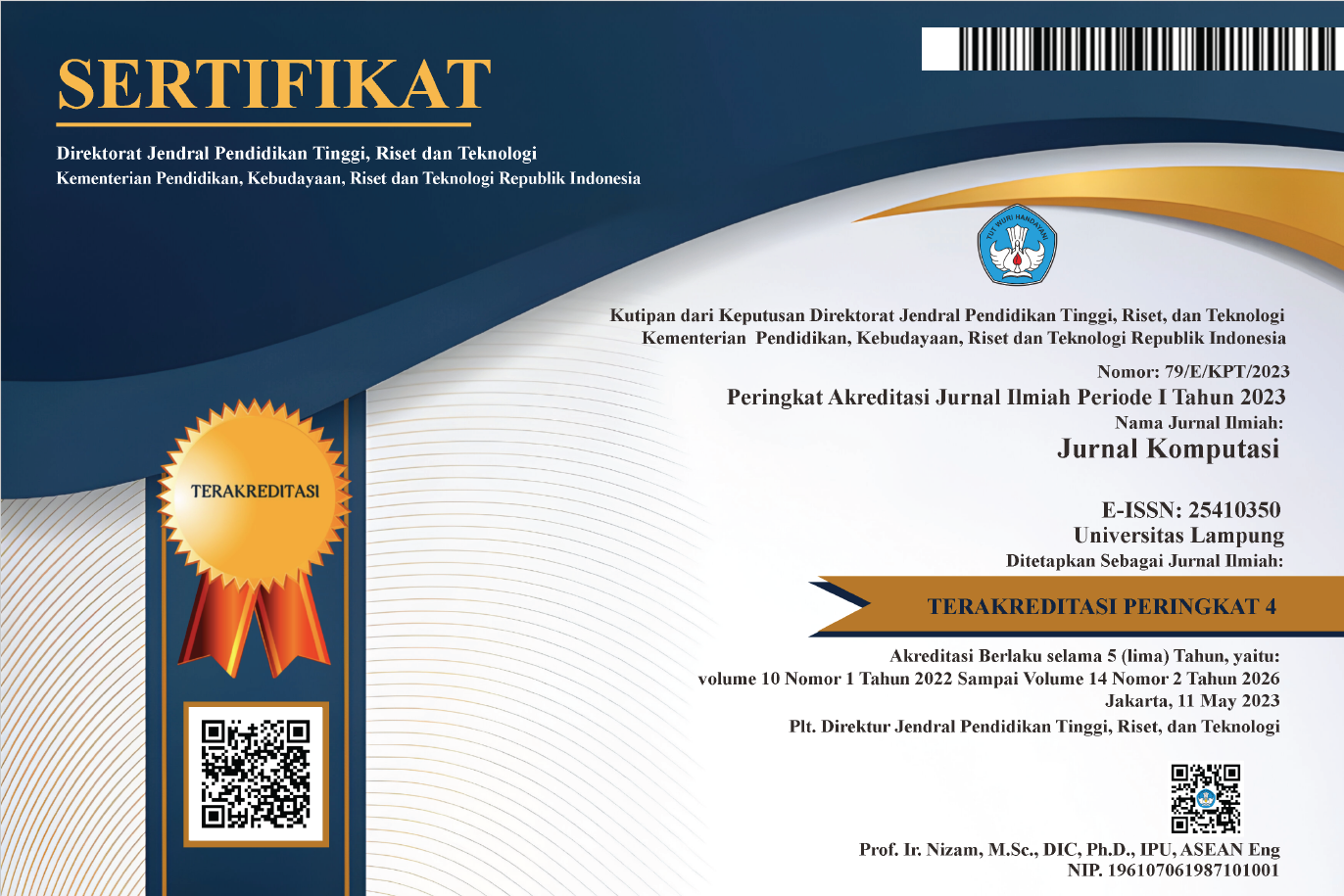
Audit Aplikasi BMKGSOFT V2 Berbasis Framework COBIT 2019 pada BMKG Provinsi Lampung
DOI:
https://doi.org/10.23960/komputasi.v13i2.321Keywords:
Climate Data, IT Governance Audit, Maturity Level, System PerformanceAbstract
Law Number 31 of 2009 states that the enhancement of economic growth, defense, security, and the protection of lives and property all heavily depend on meteorological, climate, and geophysical (MCG) information. Therefore, proper management of MCG data is crucial to prevent obstacles in the adoption of such information. As part of the next stage in implementing BMKG’s e-Government initiative, BMKGSoft V2 was introduced as an integrated and centralized online data management system to facilitate data access. However, in practice, the implementation of BMKGSoft V2 has been inconsistent, as evidenced by several issues. This study aims to audit the governance of the BMKGSoft V2 data management system using the COBIT 2019 framework, specifically the MEA01, MEA02, and MEA03 domains, to determine the extent to which system performance objectives have been achieved, conduct a gap analysis, and provide recommendations for development. The results show that the MEA01, MEA02, and MEA03 domains have achieved a capability and maturity level of 4 (Predictable Process), indicating that the BMKGSoftdata management system has well-defined IT procedures to achieve its objectives, and its performance can be quantitatively compared to established standards.Downloads
References
S. K. Routray, S. Mohanty, “Information and communications technology for a sustainable world [Climate Change],” IEEE Potentials, 43 (2), pp. 6 – 12, 2024. DOI: 10.1109/MPOT.2024.3404114
J. Mariappan, C. Krishnan, K. Shankaralingam, S. M. Abbas, “Theoretical Perspective of Role of Technology on Business Environment,” Integrating New Technologies in International Business:
Opportunities and Challenges, pp. 269 – 280, 2022
S. R. Virnandes, J. Shen J, E. Vlahu-Gjorgievska, “Generating Public Trust through Digital Government Transformation,” Australasian Conference on Information Systems (ACIS), Proceedings, 2022.
T. Taufiqurokhman, S. Evi, A. Andriansyah, M. Ma'mun, S. Endang, “The impact of e-service quality on public trust and public satisfaction in e-government public services,” International Journal of Data and Network Science, vol. 8, no. 2, pp. 765 – 772, 2024. DOI: 10.5267/j.ijdns.2024.1.002
B. Kustriyono, I. Usman, N. Kartika, V. Nadya, “Implementation of information systems in PT Terminal Teluk Lamong: Does supply chain intervene?” International Journal of Supply Chain Management, vol. 9, no. 4, pp. 379 – 386, 2020.
A. K. Ameen, D. H. Kadir, D. A. Abdullah, I. Y. Maolood, H. A. Khidir, “Assessing E-Government Effectiveness: A Structural Equation Modeling Approach,” ARO-The Scientific Journal of Koya University, vol. 12, no. 2, art. pp. 52 – 60, 2024. DOI: 10.14500/aro.11601
R. Fadrial, Sujianto, H. T. R. F. Simanjuntak, W. Wirman, W. S. Wibowo, “Fostering Trust Through Bytes: Unravelling the Impact of E-Government on Public Trust In Indonesian Local Government,” Interdisciplinary Journal of Information, Knowledge, and Management, vol. 19, 2024. DOI: 10.28945/5317
J. Chen, “The impact and value of information system audit enterprises’ risk management influencing quality assurance and system optimization - a touch from supply chain domains,” Journal of Information Systems Engineering and Management, vol. 8, no. 2, 2023. DOI: 10.55267/IADT.07.13907
M. Gupta, R. Sharman, “Modernizing Enterprise IT Audit Governance and Management Practices,” IGI Global, pp. 1-318, 2023. DOI: 10.4018/978-1-6684-8766-2
R. Eito-Brun, C. C. Aliaga, “Records and document management in the IT governance frameworks: Best practices and standardization (COBIT framework),” Revista Espanola de Documentacion Cientifica, vol. 43, no. 3, 2020. DOI: 10.3989/redc.2020.3.1666
M. Anjelina, Wella, “Information Technology Capability Using COBIT 2019 Framework (Case Study: PT. Emobile Indonesia),” Proceedings of the 7th 2023 International Conference on New Media Studies, CONMEDIA 2023, pp. 56–61, 2023. DOI: 10.1109/CONMEDIA60526.2023.10428645
I. G. M. S. Dharma, G. M. A. Sasmita, I. M. S. Putra, "Evaluasi dan Implementasi Tata Kelola TI Menggunakan COBIT 2019 (Studi Kasus pada Dinas Kependudukan dan Pencatatan Sipil Kabupaten Tabanan)," Jurnal Ilmiah Teknologi dan Komputer (JITTER), vol. 2, no. 2, pp. 354– 365, Agustus 2021
A. F. Novriyanto, N. H. Safaat, M. Affandes, “Analisis Manajemen Risiko TI Menggunakan Framework COBIT 5 Domain APO12 dan EDM03,” KLIK: Kajian Ilmiah Informatika dan Komputer, vol. 4 no. 3, pp. 1523-1530, 2023. DOI 10.30865/klik.v4i3.1396
A. Pratama, R. P. Fhonna, dan F. Liana, "Implementasi Framework COBIT 2019 pada Tata Kelola Teknologi Informasi di Dinas Penanaman Modal Pelayanan Terpadu Satu Pintu dan Tenaga Kerja Kota Lhokseumawe Menggunakan CMMI," Jurnal Ilmiah SINUS, vol. 23, no. 1, pp. 1–14, 2025
M. Saleh, I. Yusuf, dan H. Sujaini, "Penerapan Framework COBIT 2019 pada Audit Teknologi Informasi di Politeknik Sambas," Jurnal Edukasi dan Penelitian Informatika (JEPIN), vol. 7, no. 2,
pp. 204–210, 2021. https://doi.org/10.26418/jp.v7i2.48228.
Y. Utami, H. Khairi dan I. Sartika, "Efektivitas Penerapan Sistem Informasi Kearsipan Dinamis Terintegrasi di Pemerintah Kabupaten Kendal Provinsi Jawa Tengah," Action Research Literate, vol. 8, no. 4, pp. 922–933, 2024. DOI.10.46799/arl.v8i4.297J. Ayuh, and H. Chernovita, "Analysis of E-Court Incident Management in Salatiga District Court Using the ITIL V4 Framework," JATISI (Jurnal Teknik Informatika Dan Sistem Informasi), vol. 8, no. 2, pp. 585-598, 2021, https://doi.org/https://doi.org/10.35957/jatisi.v8i2.901S.
Downloads
Published
Issue
Section
License
Copyright (c) 2025 Jurnal Komputasi

This work is licensed under a Creative Commons Attribution-NonCommercial 4.0 International License.